| |
The FFS (form fill and seal) process can be Vertical (VFFS), Horizontal
(HFFS) and Tubular (TFFS), the first being the most common and older,
normally used for small items of solid or liquid products as rice,
beans, milk etc. The Tubular FFS was first used in Europe in the
80s for petrochemical products, replacing shipping bags, valve bags
made of paper, raffia and polyethylene, with great improvement in
quality and advantages in automation, in preventing package violation
and enhancing the product presentation.
By the end of the 80s the filling machines arrived in Brazil, and
rapidly consolidated a packaging pattern for Brazilian petrochemical
companies. Although the vertical and horizontal FFS are still being
used for industrial packaging, the tubular process is considered
ideal for using only two seals where the others needed three, speeding
the process and providing safer seals. Poly Embalagens specialized
in the Tubular FFS market segment.
Stages
of the process:
| 1ª
- Feeding |
The
PE and PP film rolls are fed through an unwind device
with tension control.
|
|
| 2ª
- Cut and bottom seal (form) |
The
film is transformed in bags by thermo sealing.
|
|
| 3ª
- Filling and weighing (filling) |
A
suction device opens the bag, the product is fed by gravity
and at the end electronic scales control it.
|
|
| 4ª
- Mouth seal (seal) |
The
bag is closed and transported out of the machine on conveyor
belt.
|
FFS machine:
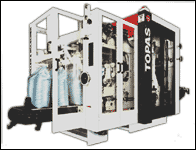
The
main tubular FFS filling machine producers are Windmoeller &
Hoelscher, BMH and Haver in Germany, BL in Italy, Piper in Spain
and Premier Tech in Canada. Depending on machine configuration and
the material to be used it is possible to fill from 150 to 2,000
bags per hour. In Brazil, Windmoeller & Hoelscher stands out
for the quantity of machines installed and the support provided
by their Sao Paulo branch.
The Film:
The
film used in the FFS process is usually supplied in LDPE, but there
is a tendency in using a mixture of polypropylene and polyethylene
for some market segments. Poly Embalagens is the only manufacturer
of this kind of film for Mercosul. The film is gusseted so that
after the filling it gets shaped like a block for easy piling.
Film quality is extremely important for good processing. As the
process keeps getting faster with the new FFS machines taking 1,800
bags per hour while the old ones took 400 bags per hour, the sealing
time is proportionally reduced leaving the uniformity of the film
as the key factor to achieving an efficient process. Poly developed
its own statistical control model with complete tracking of the
process and the materials used.
Another important feature is the blockage level. Suction is used
to open the mouth of the bag and a severe blockage will demand a
second attempt to open the bag and even to discard it, wasting time
and material.
The COF is not as important during the filling procedure but is
key for the security and presentation of the packaged material.
A low COF will cause sliding of the bags and pallet instability.
An ideal COF is usually obtained by embossing the film. Full control
of the extrusion process ensures the precision of the resin characteristics.
|
|


